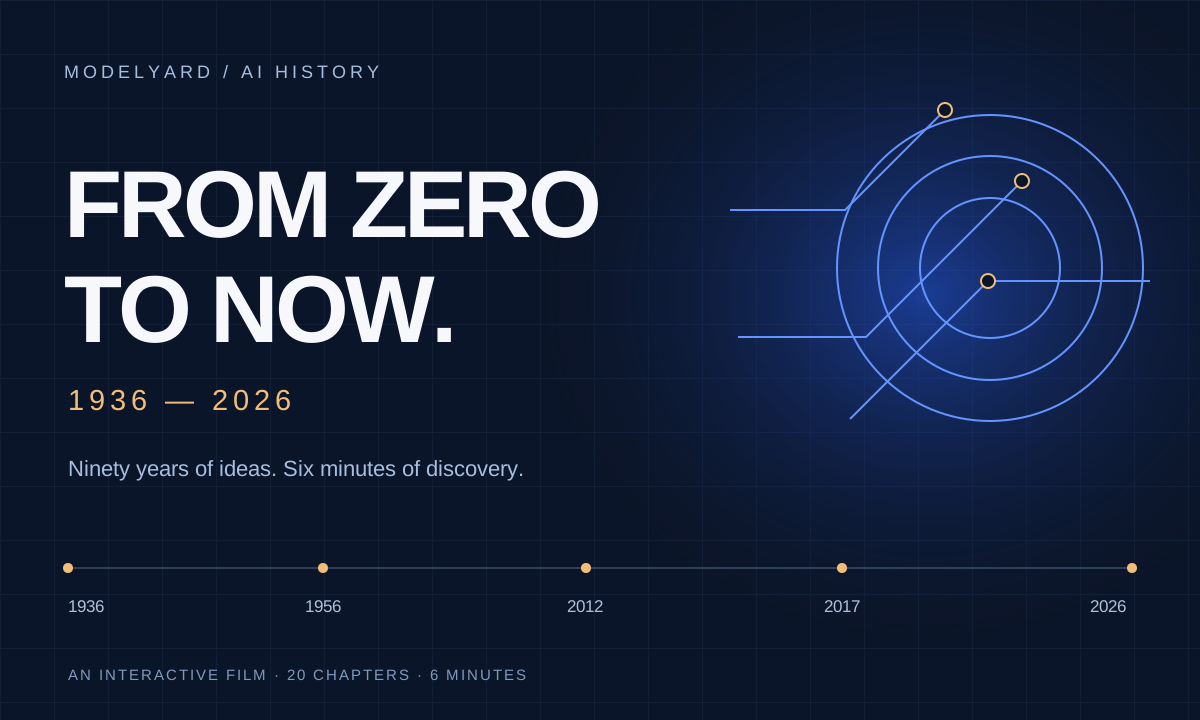
Watch, then explore
Six minutes through the turning points of artificial intelligence. Explore each chapter and follow the original sources.
Chapter notes
From zero to the frontier
AI studies machines that perform tasks such as perception, learning, reasoning and problem-solving. Its computational foundations predate its name: this film begins in 1936, while 1956 marks a landmark in AI becoming a research field. We follow selected turning points, not a single inventor or an exhaustive chronology.
Visual key: mechanisms are conceptual illustrations; numeric charts identify their metric and year.
Make thought computable
A Turing machine was neither the first physical computer nor a complete AI. It helped define algorithmic computation. McCulloch–Pitts neurons simplified nervous activity into logical operations and showed how networks could compute. Biological inspiration and mathematical abstraction developed side by side.
An artificial neuron is a computational model, not a full replica of a biological brain.
A question that opened a future
Turing replaced an ambiguous definition with a concrete conversational setting. His paper also discussed learning machines and objections. The test remains a major historical thought experiment, but conversational fluency, consciousness and reliable general capability are distinct questions.
Conversation is observable behavior. Consciousness is a separate question.
Artificial intelligence finds its name
The proposal dates to 1955; the summer research project took place in 1956. Ideas about machine intelligence already existed. Dartmouth helped gather them into a named field with shared questions, even as its ambitions exceeded the available data and computing power.
The name appears in the 1955 proposal. The landmark gathering followed in summer 1956.
Two paths. One quest.
Symbolic methods made knowledge explicit and deductions traceable. Perceptrons learned classifications from examples, but a single layer had limited linear expressive power. ELIZA's famous script used keywords and reassembly rules, exposing how easily convincing dialogue can be mistaken for deeper understanding.
Reasoning with rules and learning from examples still coexist in modern systems.
A winter could not end the quest
Expert systems created value in narrow domains but faced knowledge-acquisition and maintenance bottlenecks. AI winters varied across regions and periods; research never stopped everywhere. The Lighthill Report and McCarthy's response document disputes over goals, evaluation and combinatorial explosion.
The curve illustrates cycles of enthusiasm. It is not historical investment data.
Let error drive learning
Backpropagation applies the chain rule to efficiently compute gradients of a loss with respect to parameters. An optimizer then updates the weights. The method had earlier roots; the 1986 paper was a major popularization milestone. Depth also brings challenges in stability, data and compute.
Computing gradients and updating parameters are connected, but separate, steps.
A machine wins against the champion
Deep Blue combined specialized hardware, extensive search and chess evaluation. It was a milestone in task-specific AI, not a modern language model. Broader statistical learning emphasized estimating patterns from data and testing on unseen examples rather than only executing manually specified rules.
Generalization must be assessed on new examples and environments.
A vision revolution begins
Krizhevsky, Sutskever and Hinton combined convolutional networks, GPU training, ReLU and regularization. The 15.3% figure belongs to the paper's competition-winning system, not every single-network configuration. Top-5 error means the correct label is absent from the five leading predictions.
This chart compares top-5 error rates. Lower is better; it is not an accuracy chart.
Go reaches a historic turning point
AlphaGo was neither pure brute force nor the first Go AI. It combined deep networks, search and reinforcement learning. The 2016 system also learned from human games; later AlphaGo Zero used a different training path. The board here is constructed to illustrate the mechanism.
This is an illustrative position, not a replay of Lee Sedol's games or Move 37.
Attention opens a new era
Attention predates the Transformer. The 2017 innovation centered the architecture on attention; its encoder–decoder design is not identical to every modern model. Arrows and matrix values here are illustrative. Autoregressive decoders normally mask future tokens during training.
Attention weights describe a computation, not a complete explanation or a literal thought trace.
One model unlocks more tasks
GPT-3 is autoregressive: it learns by predicting subsequent tokens. Few-shot prompting puts examples in the context; it does not retrain every weight during inference. Parameters, data and compute interact. Model size alone is not a complete measure of intelligence or factual reliability.
In-context learning usually changes the input, not the model's permanent weights.
AI enters the life sciences
AlphaFold2 combined learning with structural constraints. Predicting a protein's structure is not a full cell simulation or a replacement for every experiment. In 2024, half the Chemistry Prize went to David Baker; the other half was shared by Demis Hassabis and John Jumper. The illustrated protein is procedural.
This depicts structure prediction, not a real protein or a physical folding simulation.
From recognition to creation
GANs and diffusion are different approaches. Diffusion typically adds noise during training and learns a reverse process. Generation is not simple internet collage, and reproducing training material remains possible. The procedural terrain illustrates noise becoming structure; it is not a live model or training sample.
Diffusion models existed before 2020. DDPM was a major milestone, not their first appearance.
One conversation. A new front door.
ChatGPT was neither AI's beginning nor the first chatbot. Its turning point joined capable language models with a widely approachable interface. The launch described reinforcement learning from human feedback and acknowledged plausible but incorrect outputs. The on-screen conversation was written for this film.
Fluent answers still need evidence and verification.
More modalities. A wider world.
Gemini 1.5 in 2024 illustrated multimodality and longer context, though supported inputs and outputs differ by system. Llama 2's 2023 release provided downloadable models under specific terms. These are historical examples, not today's product ranking. More context does not guarantee reliable recall of every detail.
Open weights, open code, open data and open licensing are distinct dimensions.
Reasoning pushes further
Pretraining compute builds a model; inference-time compute is spent while answering. Reasoning research allocates more resources to difficult tasks. Methods may involve longer sequences, sampling, search or verification. The tree is illustrative, not a universal map of model internals. R1 also explored downloadable models and distillation.
Verify the result. A longer reasoning trace does not by itself establish reliability.
Intelligence takes action
RAG retrieves external context to help update information and support attribution, but does not guarantee correctness. Agents often organize tasks, invoke tools and inspect results; tool use alone is not strong autonomy. Actions affecting real environments require bounded permissions, records and verification.
The model is one component. Tool quality and feedback matter too.
The AI wave is reshaping the world
A 2026 report does not make every statistic a 2026 measurement. $581.7 billion is 2025 global corporate AI investment. The 58→40 change concerns mean Foundation Model Transparency Index scores, not capability. This is a checked annual-report snapshot, not a live ranking or a prediction presented as history.
Investment and transparency are different measures. These numbers do not establish causation.
We write the next chapter
The film ends with a question, not an unverified date for AGI. Reliable operation in open environments, sharing benefits, evaluation and governance remain technical and societal challenges. Future possibilities should stay clearly separate from established history.
This is an open question and an editorial conclusion, not a definite prediction.
Sources & further reading
Continue exploring the original papers, research institutions and product announcements.
- Turing · On Computable Numbers / King's College archive ↗ 1936
- McCulloch & Pitts · A Logical Calculus of the Ideas Immanent in Nervous Activity ↗ 1943
- Turing · Computing Machinery and Intelligence ↗ 1950
- McCarthy, Minsky, Rochester & Shannon · Dartmouth proposal ↗ 1955 / 1956
- Rosenblatt · The Perceptron ↗ 1958
- Computer History Museum · AI & Robotics timeline ↗ 1955–1968
- Weizenbaum · ELIZA ↗ 1966
- McCarthy · Review of the Lighthill Report ↗ 1973
- Computer History Museum · Expert Systems oral history ↗ 1980s
- Rumelhart, Hinton & Williams · Learning Representations by Back-propagating Errors ↗ 1986
- IBM · Deep Blue ↗ 1997
- Krizhevsky, Sutskever & Hinton · ImageNet Classification with Deep Convolutional Neural Networks ↗ 2012
- Google DeepMind · AlphaGo ↗ 2016
- Vaswani et al. · Attention Is All You Need ↗ 2017
- Brown et al. · Language Models Are Few-Shot Learners ↗ 2020
- Jumper et al. · Highly Accurate Protein Structure Prediction with AlphaFold ↗ 2021
- Nobel Prize · Chemistry 2024 ↗ 2024
- Goodfellow et al. · Generative Adversarial Networks ↗ 2014
- Ho, Jain & Abbeel · Denoising Diffusion Probabilistic Models ↗ 2020
- OpenAI · Introducing ChatGPT ↗ 2022
- Meta · Llama 2 ↗ 2023
- Google · Gemini 1.5, multimodal reasoning and long context ↗ 2024
- OpenAI · Learning to Reason with LLMs ↗ 2024
- DeepSeek-AI · DeepSeek-R1 ↗ 2025
- Lewis et al. · Retrieval-Augmented Generation ↗ 2020
- Yao et al. · ReAct: Synergizing Reasoning and Acting ↗ 2022
- Stanford HAI · AI Index 2026: 12 Takeaways ↗ 2026
- Stanford · Emerging Technology Review: Artificial Intelligence ↗ 2026
- NIST · AI Risk Management Framework & Generative AI Profile ↗ 2023 / 2024