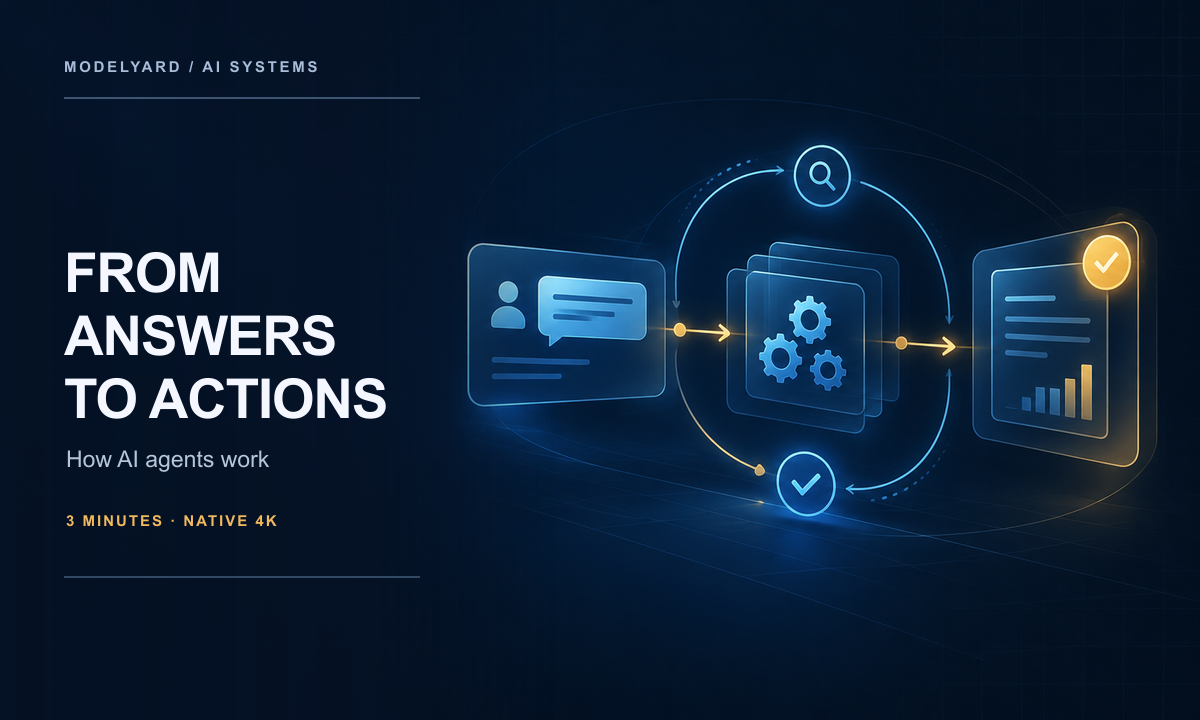
How an AI agent moves from a goal to a checked result
A three-minute tour of the agent loop: clarify a goal, use tools, inspect what comes back and verify the real outcome.
Chapter notes
From answer to action
This film follows one illustrative task: prepare a sourced brief about AI agents. It explains a system, not a live software demonstration.
The task and interface are conceptual examples.
Define what “done” means
Set the scope, evidence requirements and delivery format before the agent acts. If success is still ambiguous, ask the user instead of guessing.
A checkable finish line makes the result easier to review.
The model is one layer
One practical view places the model alongside its harness, tools and environment. Implementations differ; this is a useful design lens, not a universal taxonomy.
A model alone does not describe the whole system.
Plan before acting
An agent can break a goal into steps and use each result to choose what comes next. A plan is a working hypothesis, not proof that the task is done.
Each step should return an observable result.
Tools connect to the environment
Search and browser tools extend a model’s reach, but their results can be stale, incomplete or wrong. Inspect what came back and keep sources traceable.
Tool output is evidence to check, not a guarantee.
Observe, then adapt
Repeated tool calls can change the environment and compound mistakes. Check both the trace and the real state, and let a person stop or redirect the work.
A plausible transcript can still end in failure.
Use is ahead of agent deployment
Stanford HAI’s 2026 AI Index reports generative AI use in at least one business function at 70% of surveyed organizations; agent deployment remains single-digit across nearly all functions. The measures differ in scope.
Broad AI use does not mean agents are widely deployed.
Page text is not authorization
Prompt injection is a possible attack in which retrieved content tries to redirect an agent. Content from a page is untrusted input; it cannot grant itself the user’s authority.
Treat outside content as data, not permission.
Keep access within the task
Limit access to what the task needs and prefer read-only or contained environments. Add human approval before actions such as sending, purchasing or deleting.
Separate reading, drafting and committing.
Verify what actually changed
Check the saved result against the task criteria and traceable sources. A completion message alone cannot prove that the work exists or is correct.
Verify the outcome outside the final reply.
Sources & further reading
Continue exploring the original papers, research institutions and product announcements.